Last updated on
As the Internet of Things (IoT) market continues to grow, smart home devices are increasingly advertised by providers as an environmental upgrade. That claim holds up in some respects, as connected devices can measurably reduce energy waste.
However, this marketing rarely accounts for the costs of manufacturing these devices and the economic realities of keeping them running. If you’re deciding how far to go with a connected home, you should understand both sides to make a confident decision.
What's Inside
Areas Where Smart Homes Deliver
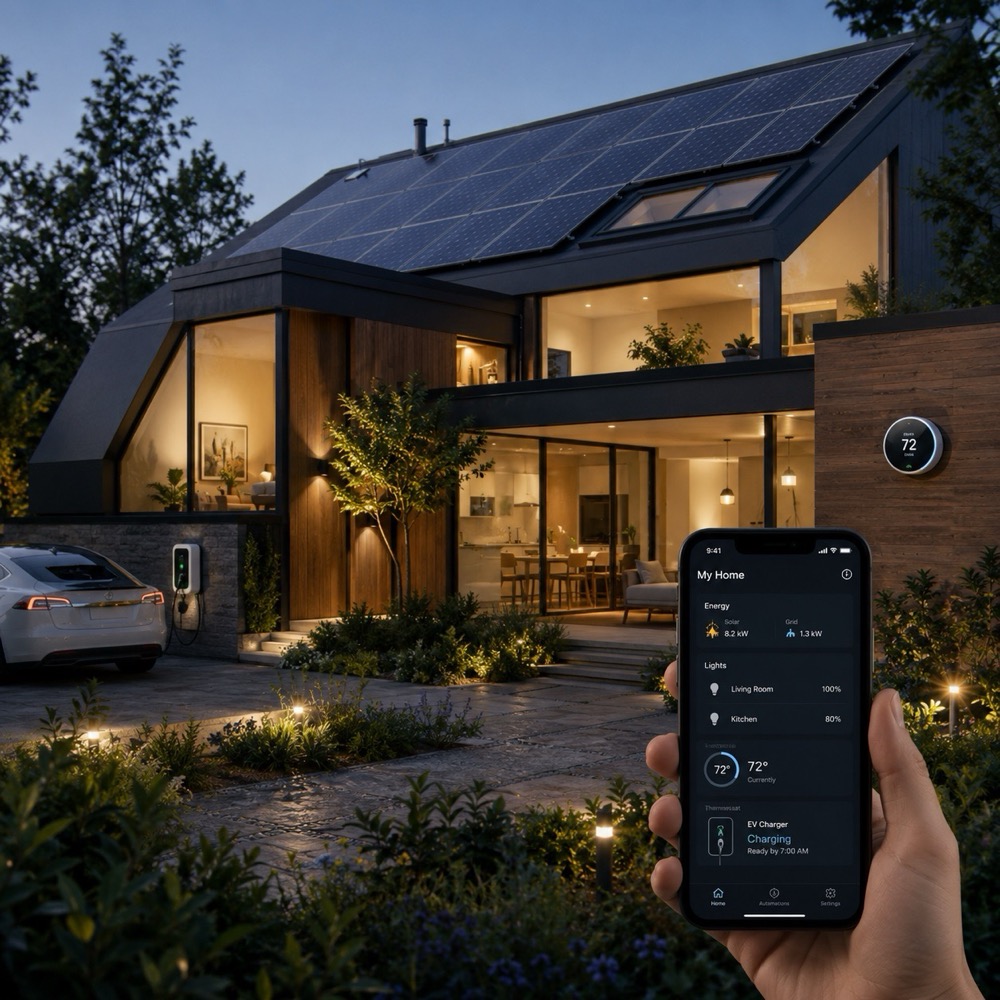
When it comes to energy efficiency, smart devices have a considerable impact. Smart thermostats can learn a household’s schedule and stop heating or cooling when you aren’t home, while smart lighting turns off automatically in empty rooms. Innovative energy-monitoring systems can show homeowners which appliances are driving utility bills.
Adoption of IoT products has grown in recent years. This surge is largely tied to measurable savings rather than novelty, even if those savings are relatively modest per device.
Some of the more significant gains come from HVAC, with heating and cooling accounting for roughly 35% of total energy consumption. A thermostat that reduces even a modest share of that number has a greater impact on a homeowner’s footprint than most other smart devices. HVAC upgrades are typically the first recommendation in any smart home energy strategy.
The Life Cycle Most Coverage Skips
It’s important to acknowledge the environmental costs of manufacturing a smart device. Circuit boards, batteries, plastics and rare materials carry an embedded carbon cost before a product reaches a living space, yet that cost is rarely factored into sustainability marketing claims.
Continuous operation is another key consideration. Smart home systems continuously monitor and automate home appliances, meaning sensors and controllers are always drawing power and transmitting data, even when a homeowner is not actively using them.
Most smart devices are constantly communicating over wireless networks using low-power protocols, sending data to a hub or cloud server that processes it and sends instructions back. While the energy cost is fairly trivial per device, it scales across a household with a dozen connected products. It scales even further across millions of households with smart home technology.
More notably, replacing these products poses unique challenges. Smart home products often have shorter usable lifespans than the appliances they replace, partly because manufacturers stop supporting an app or cloud service before the hardware itself fails. These devices could benefit from better circular technology design.
A thermostat that still functions correctly can become useless once its manufacturer shuts down the servers it depends on. This design problem is a significant contributor to e-waste that most smart home coverage leaves out.
What’s Changing on the Manufacturing Side
Parts of the industry are already moving to address these life cycle problems. Interoperability standards, including Matter, were created so devices aren’t locked to a single company’s app or cloud service, supporting better reliability and longevity of these devices. Through these industry frameworks, smart products are more likely to continue working even if a manufacturer changes direction.
Regulatory pressure is also playing a role. Right-to-repair rules taking effect in the European Union and parts of the U.S. are beginning to require replaceable components across categories, including connected devices, and targeting the shorter replacement cycles that drive e-waste growth. Such structures are especially valuable given that only 22.3% of e-waste is properly managed and recycled.
A Practical Buyer’s Framework for Smart Device Purchasing
When evaluating a new device, asking yourself a few strategic questions is integral to making a sound purchase.
Start with whether it works without the cloud, since devices that can run core functions locally are less likely to become obsolete if a company shuts down or changes direction. Check how long the manufacturer has committed to software support, ideally a stated firmware update timeline rather than general marketing language.
Check whether the smart device is built on an open standard, such as Matter, Zigbee or Z-Wave, which makes it more likely to keep functioning even after a homeowner switches hubs or brands. From there, consider whether the device can be repaired or has a replaceable battery, since a sealed unit with a nonremovable battery has a built-in expiration date.
It’s worth checking whether the company offers a take-back or recycling program, which is a reasonable sign that end-of-life was considered during design rather than ignored.
The Honest Answer
Chosen carefully, with attention to devices built to last, they reduce energy waste in measurable ways, particularly around heating and cooling. Used carelessly, with frequent upgrades and cloud-locked devices discarded as soon as something newer appears, they shift the environmental cost rather than eliminate it.
Ultimately, how long a device can remain in use and how it is designed for maintenance are the biggest indicators of whether a smart home is actually better for the environment.
Read More
 Understanding Your Septic System: Complete Guide for Rural and Suburban Homes
 Why Annual AC Maintenance Matters: The Real Cost of Skipping Tuneups
 Foundation and Crawlspace Design: Preventing Moisture Damage and Pest Entry
 Your First Steps in an Older Home (What to Inspect and Maintain)
 Welcome the Warm Weather With Pool Opening Services